

The 9AM Pastry Case Problem: Why Dulce Vida’s Shelves Empty Before the Rush Ends
At Dulce Vida cafe, the pastry case is mostly empty by 9am. The same thing happens almost every morning: a full spread at open, a steady thinning through the rush, and bare shelves well before the late-morning lull. For a cafe owner or an operations manager, that is lost sales up front and avoidable waste at the back.
This article looks at why the morning rush drains pastry inventory so quickly, and how changing production batch sizes closes the gap between what gets baked and what actually sells.
Demand does not arrive evenly. It climbs steeply between 7am and 9am, then drops just as sharply. That shape shows up in the cafe’s own daily operations, captured in this look at how Dulce Vida cafe runs its morning service.
Four operational ideas run through the piece, each building on the last:
- Morning rush demand curves – how hourly transaction volume rises and falls, and what that shape means for bake timing.
- Pastry case turnover – how quickly each item sells through, by SKU and by hour of day.
- Rework of batch sizes – recalculating how many units go into each tray, per bake cycle, instead of holding a fixed default.
- Inventory production planning – linking bake schedules to observed demand rather than to habit or a blanket daily target.
Planning starts with knowing where the cafe’s current output sits against its capacity and product range, which this overview of Dulce Vida Bakery operations lays out. From there, batch sizes become something to tune rather than a constant to defend.
Analyzing Morning Rush Demand Patterns
The morning rush arrives as a sequence of overlapping demand waves rather than a single block, and treating it as one block is the quickest way to run out of product or overbake. At Dulce Vida, transaction volume climbs from 22 in the opening half hour to a peak of roughly 92 around 8:00am, then falls off just as fast. Most of the morning’s money is made in about ninety minutes.
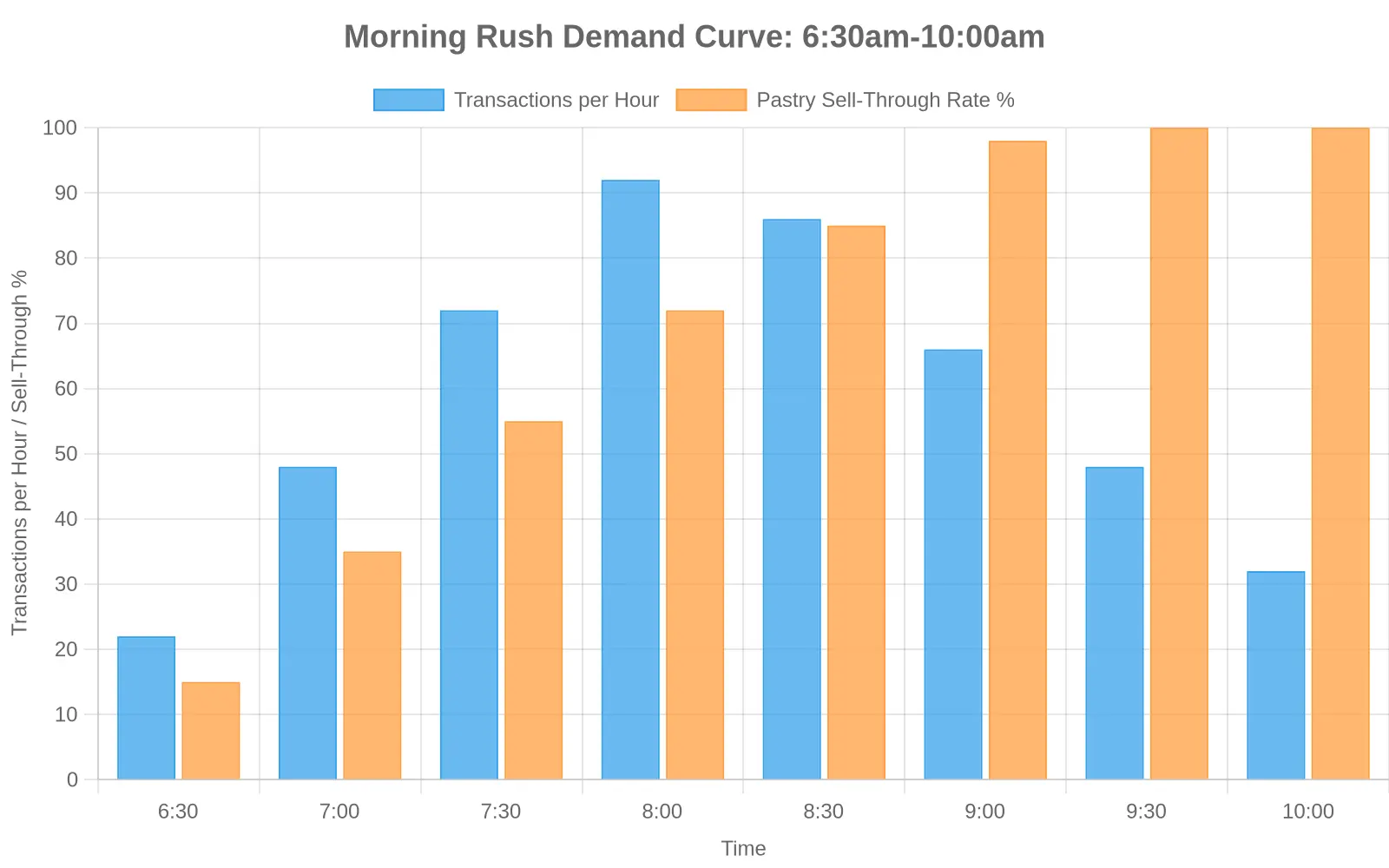
Two things change inside that window: how many people arrive, and how much they buy. Average units per transaction runs about 1.3 early, when solo commuters take a coffee and a single concha, then passes 2.1 during the 8:00am cluster, when office groups and families buy by the box. Those extra units are what empty the case.
Demand peaks across the morning like this:
- 6:30-7:00am – the opening surge; early commuters and shift workers, low units per transaction.
- 7:00-7:30am – traffic doubles as school and office runs begin.
- 7:30-8:00am – the steepest climb; transactions jump from 72 toward the day’s high.
- 8:00-8:30am – the true peak, where the highest ticket sizes land.
- 8:30-10:00am – a fast taper, but the shelves are already bare.
That compression is the inventory problem. Pastry case inventory does not deplete evenly: sell-through reaches roughly 85% by 8:30am and nearly 100% by 9:00am. Anyone searching for pan dulce near me open now and arriving late finds an empty case. To keep the case sellable all morning, shift batch timing as well as batch size. Front-load production before 7:00am, then stage a smaller mid-peak bake around 8:15am – the rhythm panaderías cercas de mi use to keep shelves full past opening. Matching bake timing to the demand curve turns a 9am sellout into a full day of margin.
Hourly Pastry Sales vs Production
The chart below tracks how many pastry units Dulce Vida sells each hour against how many it produces, from the 6:00am opening through 12:00pm.
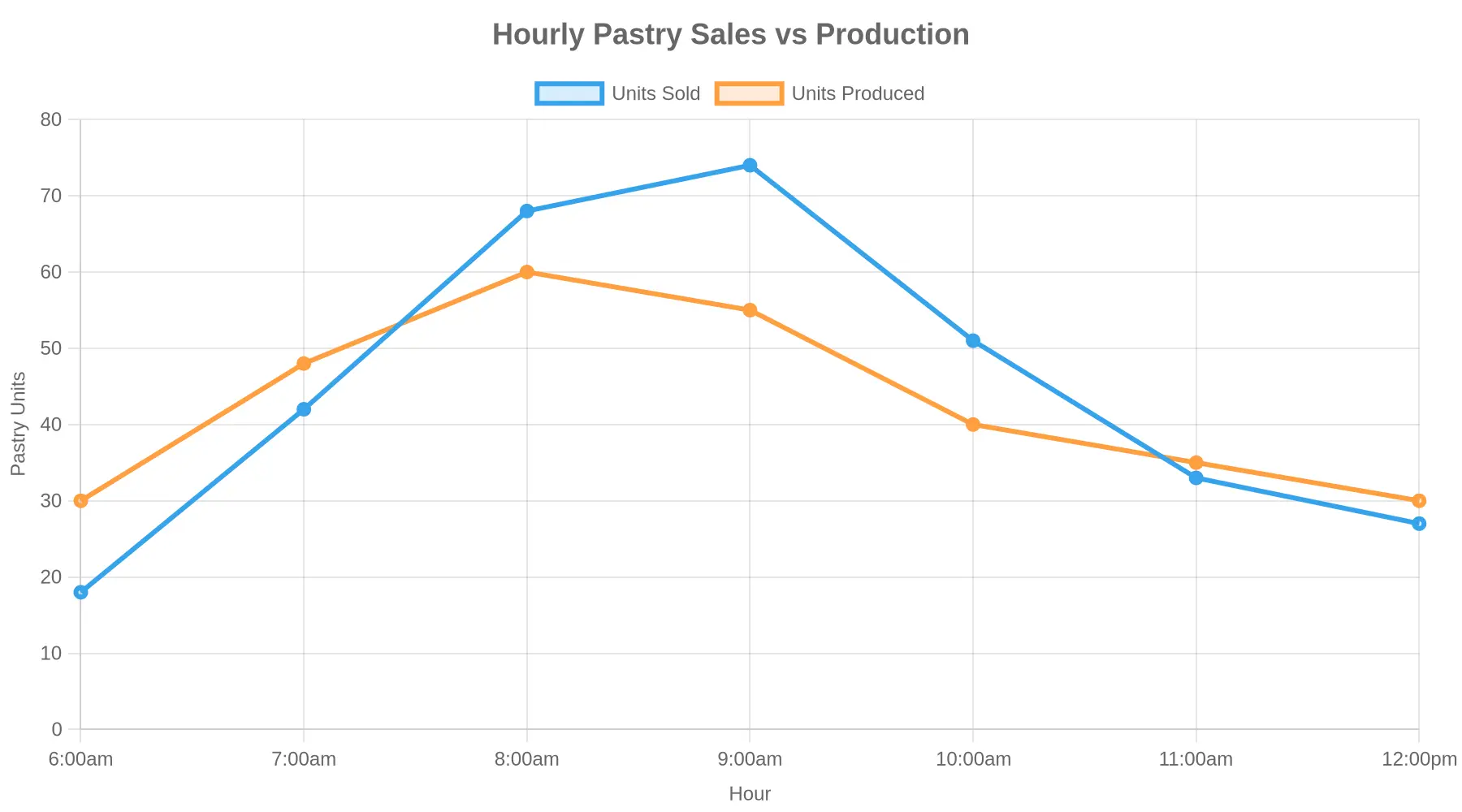
Sold units outpace produced units through the early peak, and the shortfall is widest between 8:00am and 9:00am, when demand is highest. That gap is why the pastry case looks picked clean well before mid-morning, and it points to where batch sizing needs rework.
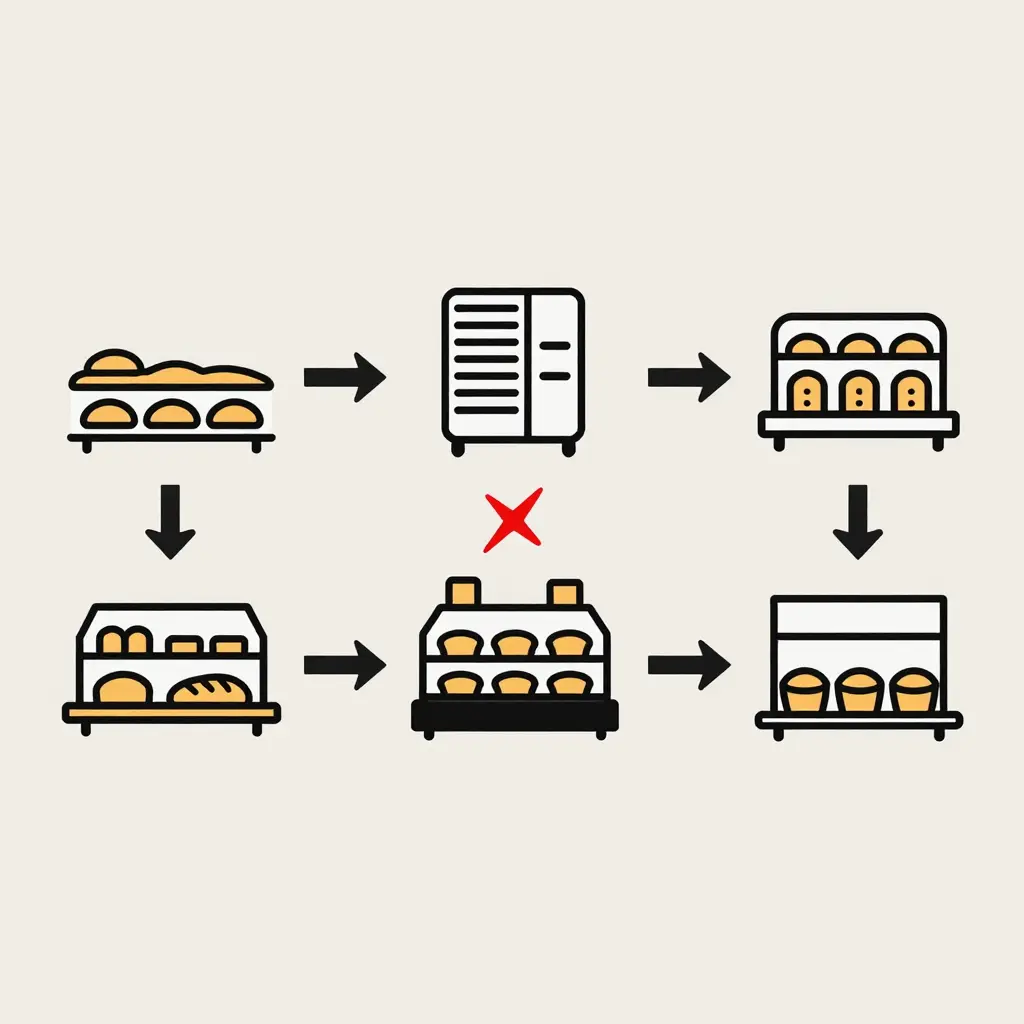
The diagram traces the five-step flow from first bake to second restock; the red marker shows where the process breaks between the first bake and the mid-morning re-bake.
Batch Sizing Fundamentals
A batch size is the number of pastry units produced in a single bake cycle, or oven load. It is the main lever for controlling pastry case availability during the morning rush, because it sets how many units sit on display at any given moment. Pastries are baked ahead of demand rather than to order, so every batch decision is a forecast.
First bake quantity is the number of units loaded before the doors open. It sets the initial fill of the pastry case and drives first-hour sell-through more than anything else. Mid-morning re-bake quantity is the volume produced in the second and later waves, usually between 7:30 and 10:00 a.m., to replace what the morning rush depletes. Those two numbers define the day’s availability curve.
Batch cycle time is the total elapsed time from tray prep through proofing, baking, and cooling to case-ready product. Oven capacity constraints are the physical limits on how many units a rack or deck oven holds per cycle, and how many cycles it completes per hour. If a cycle takes 35 minutes and a deck oven holds two racks, hourly output is fixed; bigger batches do not raise throughput, they only push back freshness.
Sell-through rate is the share of a batch sold within its target window. Waste is the unsold remainder that loses shelf quality and gets discounted or thrown out. As batch sizes grow, the two move in opposite directions.
| Batch parameter | Under-batch | Balanced | Over-batch |
|---|---|---|---|
| First bake quantity (units) | 24 | 48 | 96 |
| Sell-through by 9 a.m. | 100% (stockout) | 85% | 52% |
| Waste rate | 0% | 4% | 18% |
| Pastry case condition | Empty early | Steady | Full but stale |
The balanced column is the target: enough volume to fill the case through the morning rush without carrying dead stock into the afternoon. Operators who tune batch sizes against these numbers treat availability as a scheduling problem, not a matter of luck – the approach our team across the Columbus locations takes. The same logic applies to formats like the Bella Vida Pastry Cafe concept, where throughput per oven cycle sets how many re-bake waves are realistic before demand softens.
Table: Current vs. Recommended Morning Batch Sizes at Dulce Vida Cafe
| Pastry Category | Current First Bake Batch | Current Re-Bake Batch | Recommended First Bake Batch | Recommended Re-Bake Batch | Expected Sell-Through Impact |
|---|---|---|---|---|---|
| Pan Dulce | 60 | 24 | 96 | 36 | +15% sell-through by 9am |
| Tres Leches Slices | 36 | 12 | 60 | 24 | +18% sell-through by 9am |
| Rosca | 18 | 6 | 24 | 12 | +12% sell-through by 9am |
| Mil Hojas | 24 | 8 | 36 | 16 | +14% sell-through by 9am |
| Oreo Tres Leches | 40 | 16 | 64 | 28 | +20% sell-through by 9am |
Pan Dulce and Tres Leches Slices show the steepest recommended first-bake increases, climbing roughly 60% and 67% respectively to match morning demand. Oreo Tres Leches follows at 60%, making these three categories the highest-volume adjustments on the production sheet.
Morning Pastry Sales Mix by Category
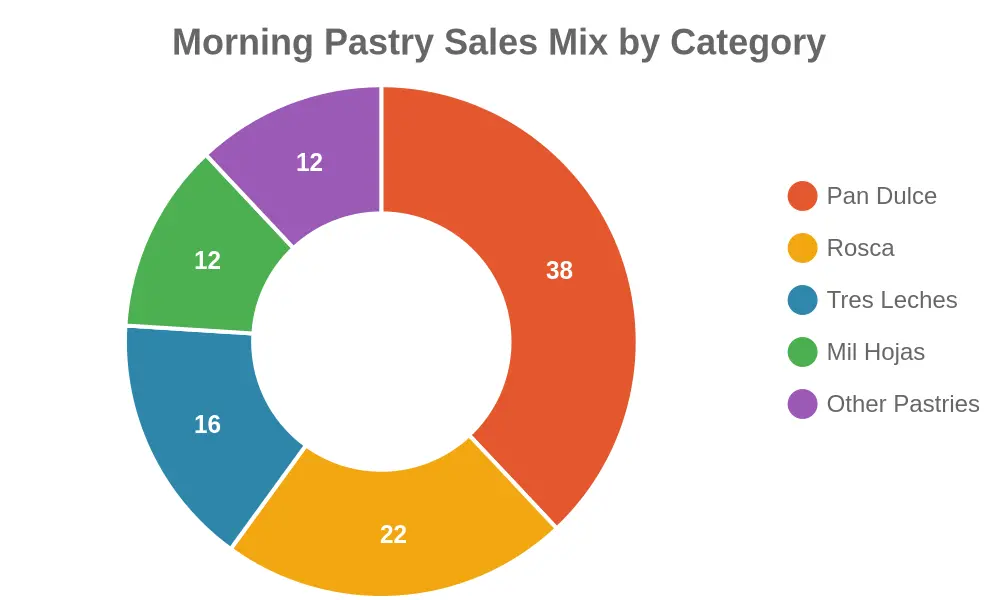
Pan dulce dominates the morning pastry case at 38% of total units sold, more than any other single category and nearly double Rosca, the next largest at 22%. Because it carries the largest share, pan dulce should drive first bake batch sizing and get priority on the earliest oven slots, ahead of lower-volume categories such as tres leches and mil hojas.
Frequently Asked Questions: Morning Rush Pastry Inventory and Batch Sizing
These are the questions cafe owners ask most when the pastry case clears too early and re-baking turns into guesswork.
Why does the pastry case empty by 9am?
Most cafes treat the pastry case as a static display instead of a demand-driven system. When first-bake output comes from habit rather than data, the busiest part of the morning rush outstrips supply. Track hourly sales for two weeks. If 40 percent of daily pastry revenue lands before 9am but only 25 percent of production does, the shortfall is structural, not a staffing problem.
How do I decide first bake batch size?
Base the first bake on your rolling seven-day average for the 6am to 8am window, then add a 15 to 20 percent buffer for variability. It is safer to start conservative and let back-bakes absorb the difference than to overproof overnight. It also helps to see how established panaderías structure their production planning across the day.
How often should I re-bake during the morning rush?
Schedule re-bakes at fixed intervals, typically every 30 to 45 minutes, and let sell-through velocity, not the clock alone, decide when to move. If trays clear faster than one per 20 minutes, shorten the interval; if they linger past 40 minutes, stretch it. Steady pacing keeps the pastry case full without flooding it.
How do batch sizes affect pastry waste?
Larger batches lower per-unit labor cost but raise spoilage risk when demand flattens. Smaller batches mean more labor but better freshness and fewer end-of-day markdowns. Aim for the point where combined labor and waste cost is lowest, usually two or three smaller bakes rather than one oversized run. Curated dessert-focused postrería menus often show how that balance works out in practice.
How do I measure sell-through rate for the pastry case?
Sell-through rate is units sold divided by units produced, expressed as a percentage. Calculate it per SKU and per hour. A healthy morning-rush target is 85 to 95 percent. Below 75 percent signals overproduction; a sustained 98 percent or higher means you are leaving sales on the table.
Should I bake to a fixed schedule or react to demand?
Use a hybrid. Anchor the first bake to your historical average, then trigger re-bakes on sell-through thresholds. That keeps batch sizes disciplined while staying responsive to real demand.
Turning the Analysis Into a Prioritized Action Plan
The fixes below follow from the data above. Apply them in order; each step feeds the next.
- Measure current morning rush sell-through. Track how quickly each pastry SKU sells from opening until 9 a.m. across a representative week. Record units sold, the time of each stockout, and the remaining inventory per item.
- Adjust the first bake upward. For items that consistently sell out before the 9 a.m. cutoff, increase opening batch sizes, using the sell-through figures to size the increase rather than estimating.
- Add a scheduled mid-morning re-bake. Introduce a fixed re-bake slot around 8:15 a.m. to replenish high-demand items before the second wave of foot traffic.
- Monitor pastry case availability against demand. Compare the merchandise on display each hour against historical demand, then refine production volumes and timing on a weekly cycle.
The cafe’s demand pattern is predictable enough that these four steps reinforce each other.
The outcomes here are operational rather than speculative. Higher opening volumes and a timed re-bake should cut stockouts at peak, and matching production more closely to demand should reduce the pastries thrown out at close. Sell-through improves, margins hold, and customers find a stocked case. To see how these practices look in a real location, review how Dulce Vida structures its daily bake.