
Introduction: Reading the Tray, Not Just the Clock
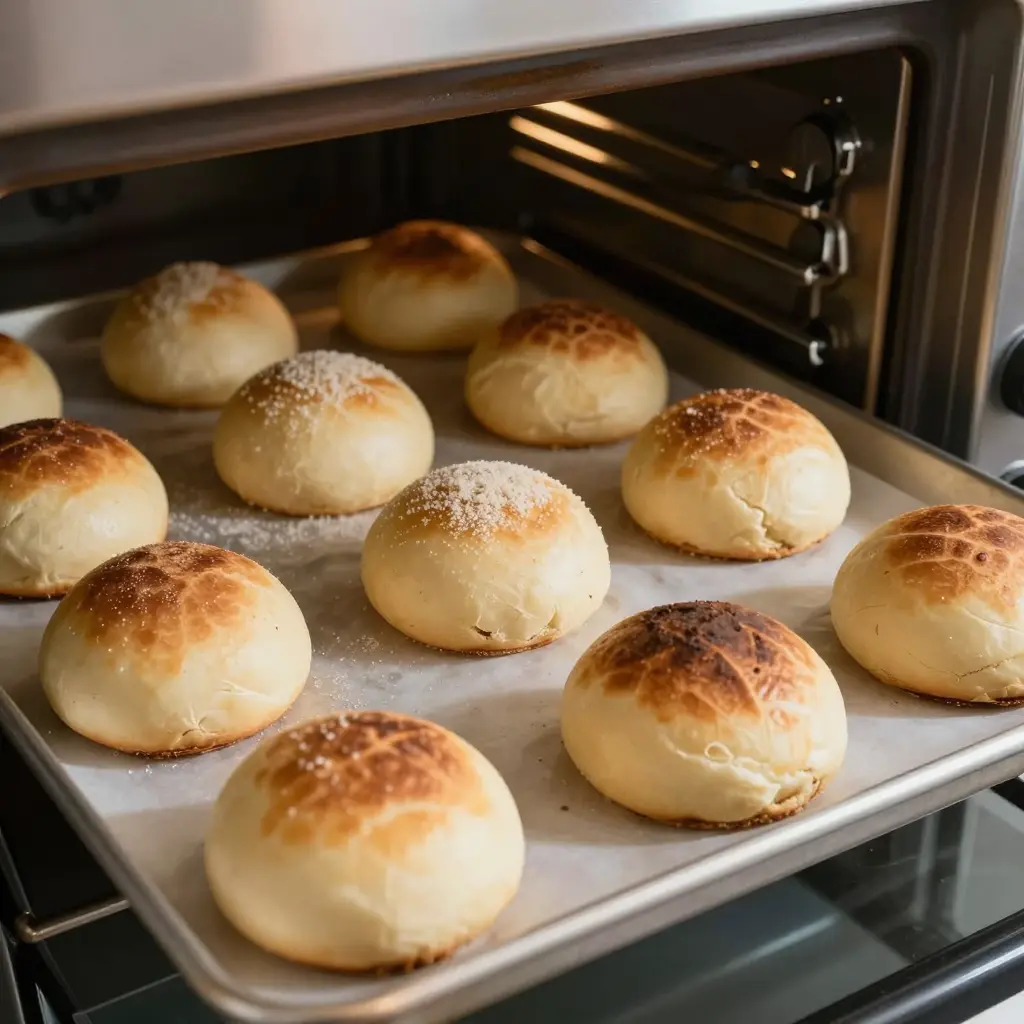
Uneven egg wash browning on a Don David Bakery pan dulce tray is not just a cosmetic defect. It records where heat, moisture, and airflow actually went during the bake, and if you read it while the trays are still in the oven, it can tell you when to rotate, when to pull, and how to time the next batch. This guide shows you how to use that read as a practical batch timing signal instead of trusting the oven timer alone.
What This Guide Covers
The scope is narrow and hands-on, built around three connected skills:
- Diagnosing browning variation – working out why one side, corner, or row of a tray browns ahead of the others.
- Reading it in real time – interpreting the pattern mid-bake, while you can still act on what the oven and dough are doing.
- Adjusting batch timing – using those readings to decide when to rotate, pull, or stage the next batch.
Who This Is For
This guide is written for commercial bakery owners and production bakers managing high-volume output, pastry chefs and artisan pan dulce makers refining consistency, and serious home bakers who want bakery-level control. If you run multiple trays at once and need repeatable results, the methods apply directly to your bench.
Everything here maps to an action – a rotation, a rack change, a pull time. The examples come from the Don David Bakery line of pan dulce trays, whose behavior under even egg wash loading makes browning differences easy to observe and learn from. No lab equipment required; a consistent wash and a careful eye are enough.
The Baking Science Behind Egg Wash Browning
A single brushstroke of egg wash looks effortless, yet it sets off a chain of chemical reactions that determine whether a tray of pan dulce emerges glossy and evenly bronzed or stubbornly pale. Knowing what happens at the dough surface lets production bakers control color instead of hoping for it.
Two Reactions, One Golden Crust
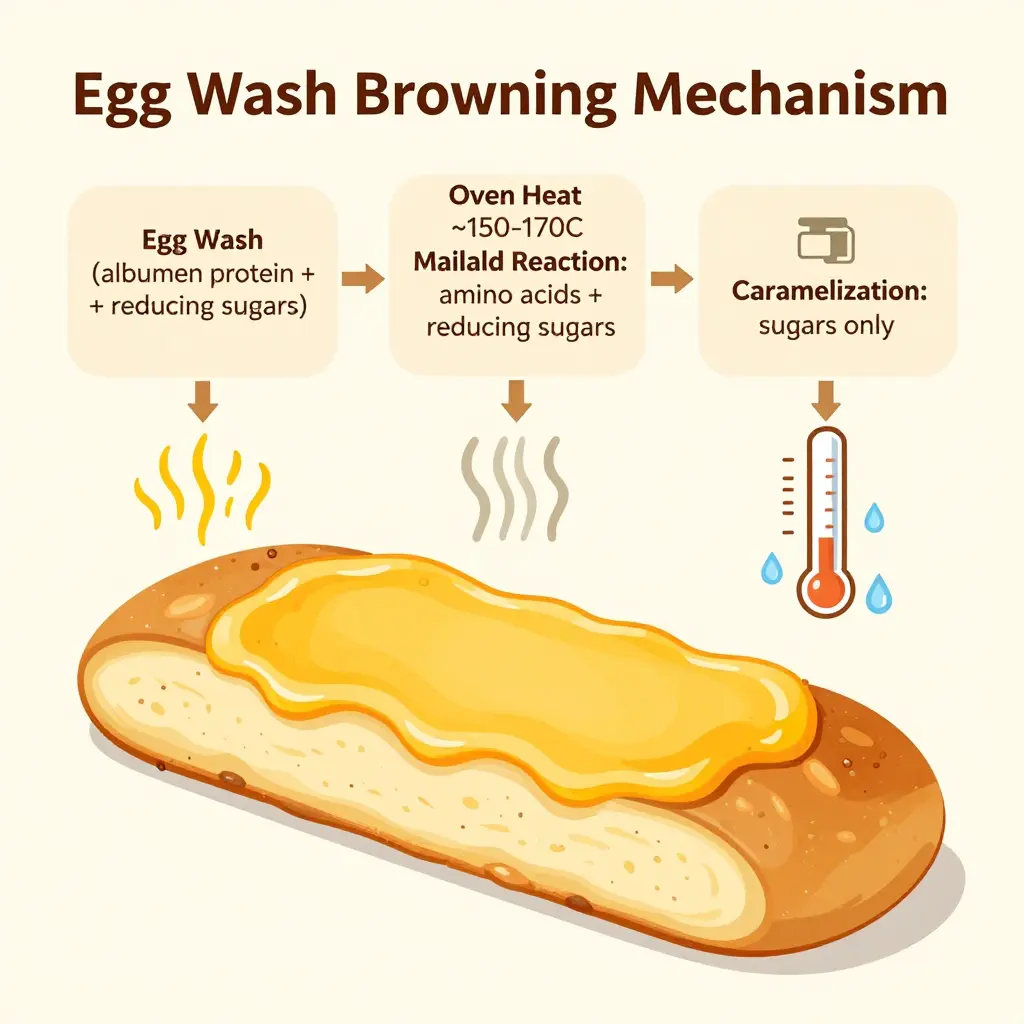
Egg wash browning is the visible outcome of two overlapping events. The Maillard reaction is a non-enzymatic browning in which amino acids (the building blocks of protein) react with reducing sugars under heat. Caramelization is a separate, sugar-only reaction that starts once surface sugars pass roughly 150-170 C (300-340 F), with no protein required. An egg wash conveniently supplies both reactants: proteins for Maillard, sugars for caramelization.
Egg White Protein and Reducing Sugars
Egg white is mostly water, and its dominant protein is ovalbumin – a soluble protein that denatures and browns readily. A splash of milk or cream adds lactose, a reducing sugar, while the yolk contributes fats and color pigments that deepen the final shade. More reducing sugars mean faster Maillard development; too few and the crust stays straw-pale.
Surface Moisture and Humidity
Browning stalls while the surface is wet, because evaporating water pins the crust near 100 C. Residual moisture, thinned egg wash, and high oven humidity all delay the reaction. A dry, well-ventilated oven pulls that moisture away quickly, allowing color to set sooner.
Radiant vs. Convective Heat
Radiant heat, from heating elements or a hot stone, transfers energy straight to the surface and drives browning fast. Convective heat, delivered by moving air, is gentler and more even. Oven airflow is decisive: strong convection strips moisture and evens color, but excessive drafts create cold spots and patchy trays. Balancing both is what separates a uniform batch from a blotchy one.
For background on the bakery behind these trays, see Don David Bakery.
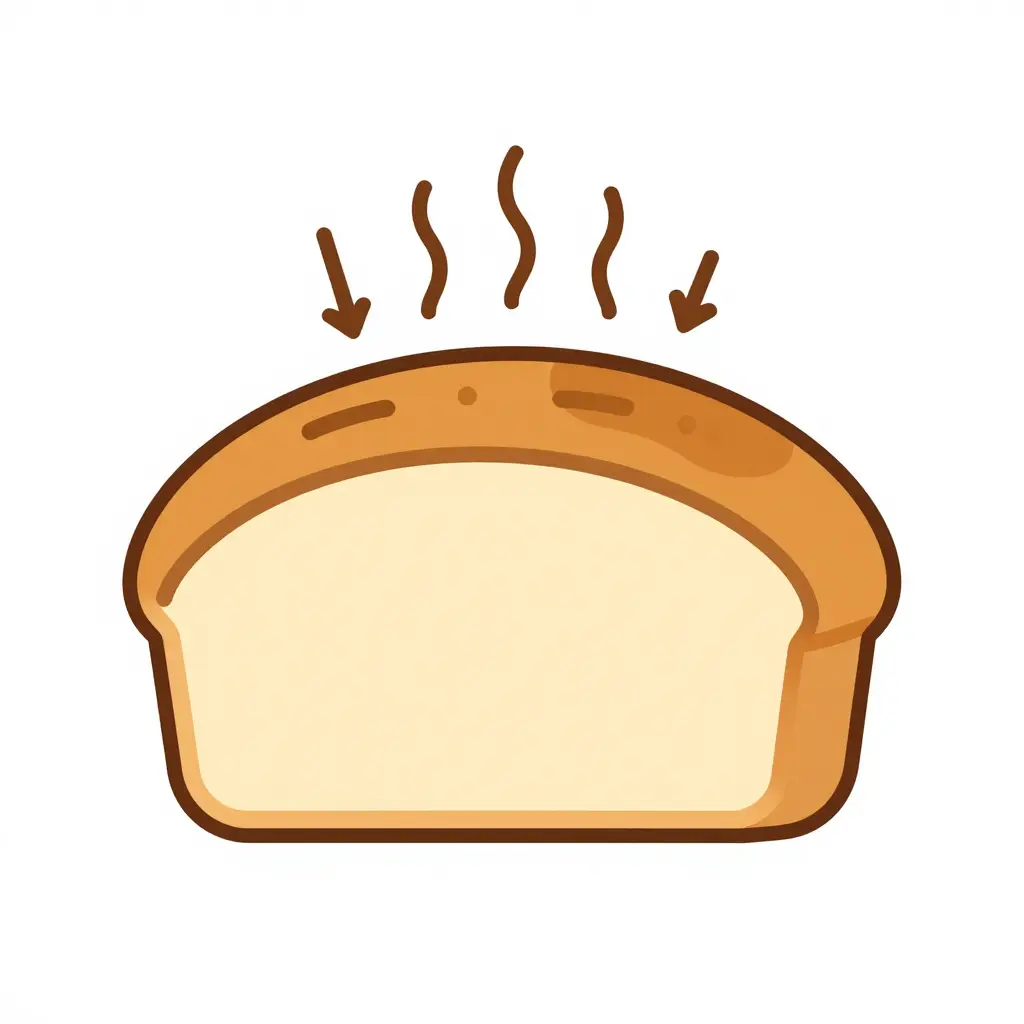
This cross-section shows how the egg wash layer sits as a distinct film on the surface of the pan dulce. In the diagram, the downward arrows represent radiant heat from above, while the horizontal wavy arrows represent airflow moving across the top. The exposed egg wash layer dehydrates and browns through Maillard reactions and caramelization, while the dough beneath stays largely insulated. That single-surface dynamic is the reason whole trays of pan dulce brown unevenly: any variation in heat delivery or airflow across the surface directly changes how that thin film develops color.
Why Egg Wash Browns Unevenly Across Pan Dulce Trays
When a full sheet of Don David Bakery pan dulce trays browns in a synchronized sweep, the bake is on track. When some pieces darken early while their neighbors stay pale, the cause is rarely the egg wash recipe itself. Uneven browning almost always traces back to thermal and physical variables in the oven and on the bench. The causes below are ordered by how often they turn up in real production.
Rack Position and Radiant Load
Rack height determines how much direct radiant energy each tray absorbs. Trays on the lower rack sit close to the bottom elements, so their bases set and color faster, while top-rack trays take the hardest hit from overhead elements and brown first on the crown. Without mid-bake rotation, this load imbalance produces the classic top-dark, bottom-light split across a single bake.
Oven Hot Spots
Very few ovens heat evenly. Elements, door seals, and airflow paths create persistent hot spots, typically near the back wall and upper corners, where pan dulce browns minutes ahead of the rest of the tray. Map those zones once with a set of cheap test tiles and you remove endless guesswork later.
Convection Versus Radiant Heat
Convection ovens move air and transfer heat through forced circulation, which colors surfaces evenly but can dry exposed egg wash and cause premature gloss loss. Radiant (deck) ovens rely on direct infrared from stone and elements, producing deeper, more directional browning. Move a tray between the two heat modes and it will never brown symmetrically, so standardize the mode for the whole bake.
Egg Wash Application Thickness and Uniformity
Egg wash is a glaze, not a coat of paint. A thick, uneven brushstroke pools in crevices and along scored edges, where it browns far faster than thin patches do. The result is streaky, blotchy browning. Strain the wash, lay down a thin, even film, and keep brush angle and pressure consistent from piece to piece.
Tray Loading Density
Crowding restricts airflow and traps steam. Oversized trays packed edge to edge shield each other from radiant heat and slow moisture escape, so interiors stay pale while exposed edges burn. Leave consistent gaps between pieces, and run the same piece count per tray every time, to stabilize color development.
Dough Surface Hydration
A wet, tacky surface dilutes the egg wash and reflects heat, delaying the Maillard reaction. A dry, skinned surface grabs the wash and browns quickly. Proofing humidity, bench time, and handling all shift surface hydration, so identical washes behave differently from tray to tray.
Proofing Variance
Pieces that proof longer have thinner, more gas-permeable surfaces and higher residual sugar at the crust, which browns faster. Underproofed pieces sit dense and cold and brown late. Uneven proofing, whether from a cold spot in the proofer or staggered loading, is one of the most overlooked drivers of uneven browning.
Quick Reference: Cause and Browning Effect
| Cause | Primary Browning Effect |
|---|---|
| Rack position | Top-dark / bottom-light split; faster base set low |
| Oven hot spots | Localized early browning near back and corners |
| Convection vs radiant | Gloss loss vs directional darkening |
| Egg wash thickness | Streaky, blotchy pooling along scores |
| Tray density | Pale shielded centers, burnt edges |
| Surface hydration | Delayed vs rushed Maillard browning |
| Proofing variance | Fast-browning overproofed vs late underproofed |
What These Causes Share
Read together, these variables explain nearly every batch that browns inconsistently. The fix is rarely a new egg wash formula; it is controlling heat distribution, loading, and proofing so every piece enters the oven under the same conditions. Dial those in, and even browning becomes a dependable sign that the process is under control.
Quick-Reference Diagnosis: Reading Browning Patterns as a Batch Timing Signal
On a loaded pan dulce tray, uneven egg wash browning is rarely random. Because heat, airflow, and radiant load differ across the deck, each recurring pattern points to a specific mechanical or environmental cause and tells you something concrete about where your batch sits in the bake timeline. Use the table below as a fast diagnostic key on the production floor, then cross-check it against the tray layout and oven behavior you can inspect on a standard Don David Bakery run.
| Browning Pattern | Likely Cause | Batch Timing Interpretation |
|---|---|---|
| Front-left over-browning | Hot spot from door seals, radiant edge exposure, or uneven burner flame at the front-left quadrant | Batch is running ahead of schedule in that zone; pull timing back or rotate trays earlier in the cycle |
| Back-right paleness | Weak airflow, blocked venting, or a cooler rear corner with reduced convective heat | Batch is lagging in that zone; extend dwell or shift the tray deeper for a longer effective bake |
| Uniform edge-ring darkening with pale center | Outer pieces receiving more radiant and edge heat than the center mass | Batch is on pace overall but over-baking at the perimeter; center pieces signal true doneness timeline |
| Patchy mottling (blotchy highs and lows) | Inconsistent egg wash application, pooled glaze, or turbulent airflow over the surface | Timing is unreliable per piece; standardize the wash and treat the batch as variable, not uniform |
| Top-rack versus bottom-rack disparity | Vertical temperature gradient between deck levels and differing rack positions | Batch timing must be set per rack; top rack signals earlier finish, bottom rack runs late |
| Delayed overall browning across entire tray | Oven under-temp, damp dough, excessive wash pooling, or overloaded deck blocking airflow | Entire batch is behind its timing signal; recalibrate the target and check oven recovery before the next run |
How to Use This Table
Treat each pattern as information, not a defect to apologize for. When two or more rows match what you see on the same tray, the causes are probably compounding – a hot spot combined with an airflow blockage, for instance – and the batch is falling further out of alignment. Standardize your egg wash, level your tray loads, and log the pattern next to the clock time for every bake. After a few production cycles you will be able to predict doneness from the browning alone instead of relying on guesswork.
Reading Browning as a Real-Time Timing Signal
On a busy production floor, you cannot crack the oven door every ninety seconds to probe every concha. You do not need to. The egg wash across your pan dulce trays is a live readout of internal doneness that updates as the bake proceeds, and learning to interpret its browning progression is what separates a consistent operation from one that pulls trays on guesswork.
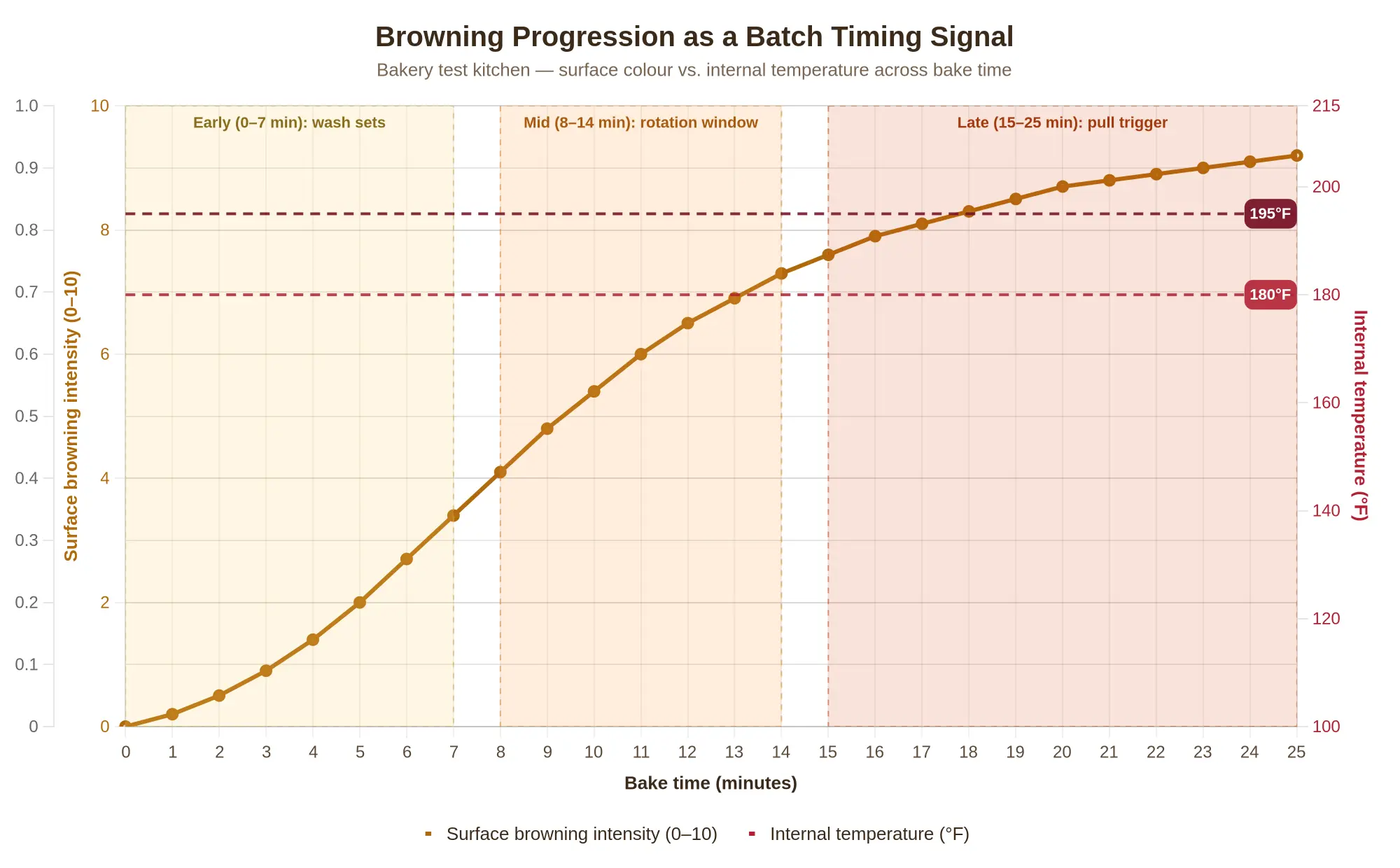
Early Stage: The Wash Sets (0-7 minutes)
In the first few minutes, the egg wash should shift from wet gloss to a matte, tacky sheen as surface moisture evaporates. The interior is still raw – starchy, dense, and nowhere near set – and the color is pale gold with no darkening at the edges. No rotation and no pull. If isolated patches darken this early while neighbors stay pale, you are diagnosing an oven hot spot, not a timing problem.
Mid Stage: Color Uniformity (8-14 minutes)
By the midpoint, the wash should reach an even golden tone edge to edge – your rotation window. The crumb is firming but still flexible, and internal temperature is typically climbing through 170-185 degrees F. Rotate 180 degrees now, while the dough can still forgive the move. Uneven front-to-back color at this stage confirms a hot zone worth logging against your rack position.
Late Stage: Deep Amber Signals Doneness (15-25 minutes)
The final minutes bring a deep amber to light mahogany sheen – your pull trigger. When color reads uniformly rich, the interior has usually crossed 190-200 degrees F and the crumb is fully set. Pull the batch. If the wash is already dark while the center still feels heavy, you waited too long between the mid and late stages.
The Takeaway
Read color as a countdown, not a decoration. Use the Don David Bakery pan dulce trays as a real-world benchmark of consistent browning, then calibrate your own pull and rotate times against what you actually see.
Why Rack Position Drives Egg Wash Browning
Walk past any commercial oven mid-bake and you will see it: the pan dulce on the top rail blushing deep amber while the tray sitting on the bottom deck still looks pale and underdone. That contrast is not random. It is thermal geometry, and once you learn to read it, rack position becomes one of the more reliable timing cues on the line.
The principle is straightforward. Egg wash browns through a combination of the Maillard reaction and surface dehydration, both of which accelerate with radiant heat and dry, moving air. The upper rack sits closest to the oven’s top elements and receives the most direct radiant load, so it browns first and darkest. The bottom rack catches more conductive heat from the deck but far less radiant exposure, leaving it lighter. Edge and front positions of the same tray dry out faster than the sheltered center, creating that familiar patchwork of tones.
The table below gives average browning intensity (measured on the L* scale, where a lower number means a darker, more advanced bake) across positions within a single pan dulce tray batch. Read it as a gradient rather than a set of isolated numbers.
What the Data Tells You
| Rack Position | Average Browning (L*) | Relative Doneness |
|---|---|---|
| Top | 58 | Darkest / most advanced |
| Upper-Middle | 63 | Advanced |
| Center | 68 | Baseline reference |
| Lower-Middle | 74 | Lagging |
| Bottom | 81 | Lightest / least advanced |
| Front-Edge | 72 | Dry edge, variable |
A spread of roughly 23 L* units across a single batch is enormous for a product where visual uniformity is the whole point. Treat the center of the tray as your reference point, then watch how quickly the top position advances past it. The table’s own top-to-center gap is 10 L* units, already past the roughly 8-unit mark where radiant heat is usually running too hot or the batch has gone too long between rotations.
The strategic takeaway: bake to the slowest position, not the fastest. The bottom rack is your true doneness clock, and the top rack is your warning light. Rotate trays at the midpoint, or drop the top rack ten to fifteen percent of the total bake time before the bottom, and your browning will converge. Consistency here is engineered, not luck; the teams documenting these methods at Don David Bakery treat rack mapping as a standard part of tray setup.
Turning It Into a Practical Habit
- Map your oven once. Run a full tray, photograph each position at the target bake time, and record the tonal spread. That snapshot becomes your baseline.
- Label rack zones. Mark top, middle, and bottom so every baker on the line uses the same labels.
- Calibrate rotation to the gradient. The wider the spread, the more aggressive your rotation schedule needs to be.
- Use edge dryness as an early cue. If front edges are cracking or overly dark while the center still drags, your airflow is uneven, not just your heat.
Rack position is the variable most bakers ignore because it hides inside the oven door. Bring it into the open, measure it, and it stops being a nuisance and starts being a tool.
Reading the Tray: Observable Egg Wash Browning Cues
Reading egg wash browning is less about staring at a clock and more about reading the tray in front of you. On a full pan dulce sheet, the surface shows how far each piece has traveled, and those signals double as your most reliable batch timing checkpoint. Train your eye on these cues:
- Even sheen development – a uniform, glossy reflection across every piece means the wash has set and is caramelizing at the same rate; this is your green light for consistent color.
- Edge darkening – the thinnest rim of each piece turns deep amber first, so early edge browning warns that the pan’s hot spots are running ahead of the whole batch.
- Patchy pale zones – dull, matte patches lagging behind the rest signal uneven wash coverage, trapped steam, or cool spots sitting on the tray.
- Surface blushing – a light rosy-gold flush spreading from the center outward shows the interior is fully set and sugars in the wash are beginning to brown.
- Matte drying – the wash losing its wet gloss and turning dry and slightly tacky indicates the surface has finished setting and beyond this point color climbs fast.
- Center-to-edge gradient – when the contrast between a pale middle and a dark rim keeps widening, batch timing is drifting and a tray rotation is overdue.
- Steam venting at the base – wisps near the bottom edge mean moisture is still escaping, a hint to ease off the top heat before the crust over-darkens.
Read these cues together rather than in isolation, and you will catch runaway color before an entire Don David Bakery pan dulce tray is lost to a single uneven pass.
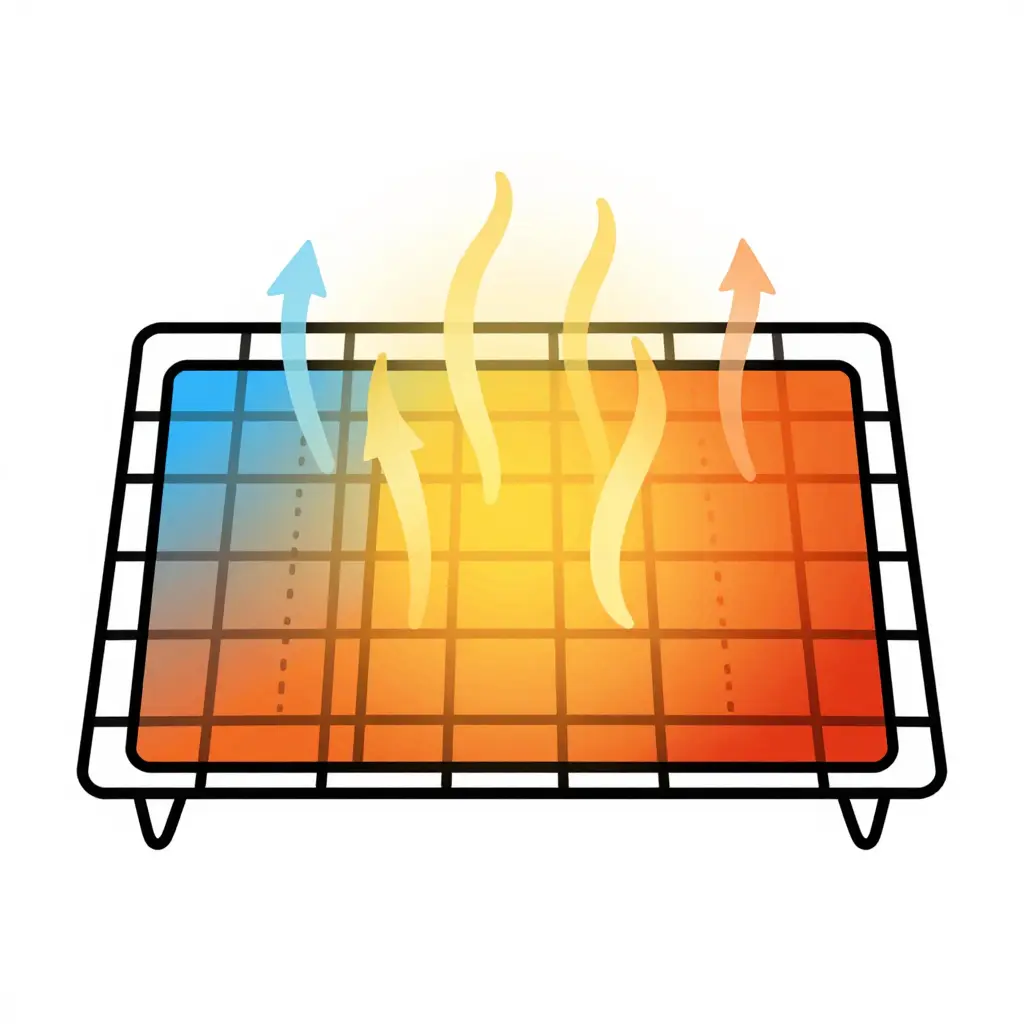
Above: a simplified flat schematic of a single oven rack split into distinct heat zones, with curved airflow arrows tracing how radiant and convection heat drifts upward and sideways across the tray. The left, center, and right bands are tinted differently (blue through red) to reflect the reality that no commercial deck or convection oven delivers perfectly even heat. This is why a pan dulce tray never browns uniformly: zones that run hotter set egg wash faster, while cooler zones lag behind. Reading that gradient on the rack, rather than the clock, is what turns uneven browning into a reliable batch timing signal.
Frequently Asked Questions
Does the type of egg wash affect browning uniformity?
Yes. Whole-egg washes brown slowly and evenly, while yolk-only or sugar-added washes caramelize faster and more unevenly. For consistent results on pan dulce trays, whisk whole egg with a splash of milk or water, strain out the chalazae, and brush a thin, even coat. Thick or patchy application causes more uneven egg wash browning than anything else.
How do I compensate for oven hot spots?
Map your oven first. Bake a test tray of scrap dough and note where pieces darken fastest. Rotate trays 180 degrees at the midpoint, or swap rack positions top to bottom. Convection ovens need lower temperatures and shorter times. Once you know the heat pattern, you can use it to pull consistent color on every run.
Is browning a reliable doneness indicator?
Not on its own. Surface color reflects sugar and protein reactions, not internal crumb development. Use uneven egg wash browning as a visual cue alongside bake time, internal temperature, and the tap test. For enriched pan dulce, target roughly 190-200 F internally. Treat color as a signal, never as absolute proof.
How does tray material influence results?
Dark, heavy-gauge steel absorbs heat and browns bottoms quickly, while light aluminum reflects it, slowing color formation. Silicone mats insulate and reduce browning further. Warped or unevenly coated pan dulce trays create hot and cool zones of their own. Match your wash thickness and bake time to the material, and keep trays flat and spotless.
How should I train staff to read the batch timing signal?
Start with a color standard: photograph your ideal bake and post it at the oven. Teach bakers to watch for the first golden blush on the pan dulce trays as the cue to rotate or pull. Run paired test batches, then quiz staff on timing. Log results so the signal stays consistent across shifts and turnover.
How does humidity affect outcomes?
High humidity slows surface drying, so egg wash stays tacky and browns unevenly, while low humidity dries and darkens it fast. Proofing boxes add moisture that can cause blotching. Control the room, avoid over-proofing, and adjust wash thickness seasonally. A stable environment makes your batch timing signal far more predictable.
What exactly is a batch timing signal?
It is the first visible milestone in the bake – usually the moment the egg wash reaches a light golden blush – that tells you how far the entire batch has progressed. Because every piece shares the same oven and wash, that first color change synchronizes your rotates, pulls, and next-tray loading for consistent output.
Conclusion and Key Takeaways
Egg wash browning follows a predictable rule: the more protein and sugar you brush on, and the more surface moisture that evaporates first, the faster the crust darkens. It is Maillard browning plus a touch of caramelization, driven by heat and time – nothing mysterious, just chemistry you can control.
That is exactly why even browning rarely looks uniform across a full run of pan dulce trays. Tray position, oven hot spots, steel thickness, and the rushed brushing that happens at the end of a shift all push the timing around by a minute or two. Variation is the norm, not a mistake.
The practical move is to stop fighting that variation and start reading it. When the first tray hits a deep golden tone, that color becomes your batch timing signal – the cue to check the remaining pans, rotate them, and pull each one on its own color instead of a single clock.
What This Means on the Bench
- Judge doneness by color, not just minutes, especially on the last trays of a run.
- Standardize your egg wash ratio so the timing signal stays consistent from day to day.
- Log each bake so repeatable browning produces repeatable results.
Treating color as the batch timing signal turns a common complaint into a control tool. The payoff is visible to anyone looking for fresh pan dulce near them: evenly colored, evenly textured, evenly flavored pan dulce trays every single time.