
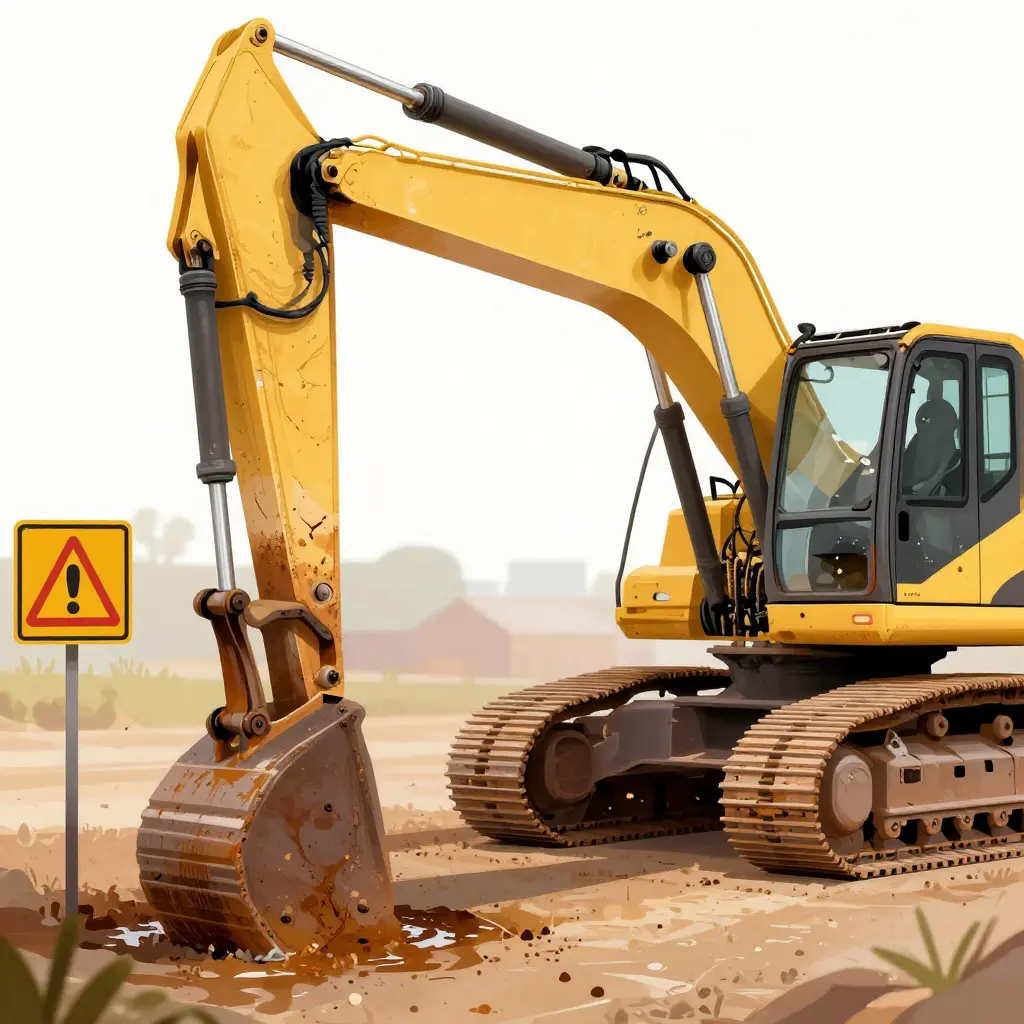
Excavator Hydraulic Oil Contamination: Early Warnings Before Pump Failure
Excavator hydraulic oil contamination is the buildup of particles, water, air, or chemical impurities in the fluid that powers an excavator’s hydraulic system. The oil is no longer clean enough to do its job. Debris small enough to be invisible still scratches precision metal surfaces, clogs filters, and weakens the oil’s ability to lubricate and carry pressure.
Contamination is one of the most common causes of hydraulic pump failure on construction equipment, so the early symptoms are worth knowing. Pump tolerances are measured in microns, and particles that circulate in the oil wear internal components, add heat, and speed up damage. Water brings corrosion and cavitation; trapped air causes erratic pressure. The damage compounds, and the pump usually fails with little warning and a long downtime.
This article covers the early warning signs, where the contamination comes from, how to test for it, and the maintenance practices that keep a hydraulic pump alive, so operators and technicians can catch a problem while it is still a cheap oil change.
How Contaminated Hydraulic Oil Leads to Pump Failure
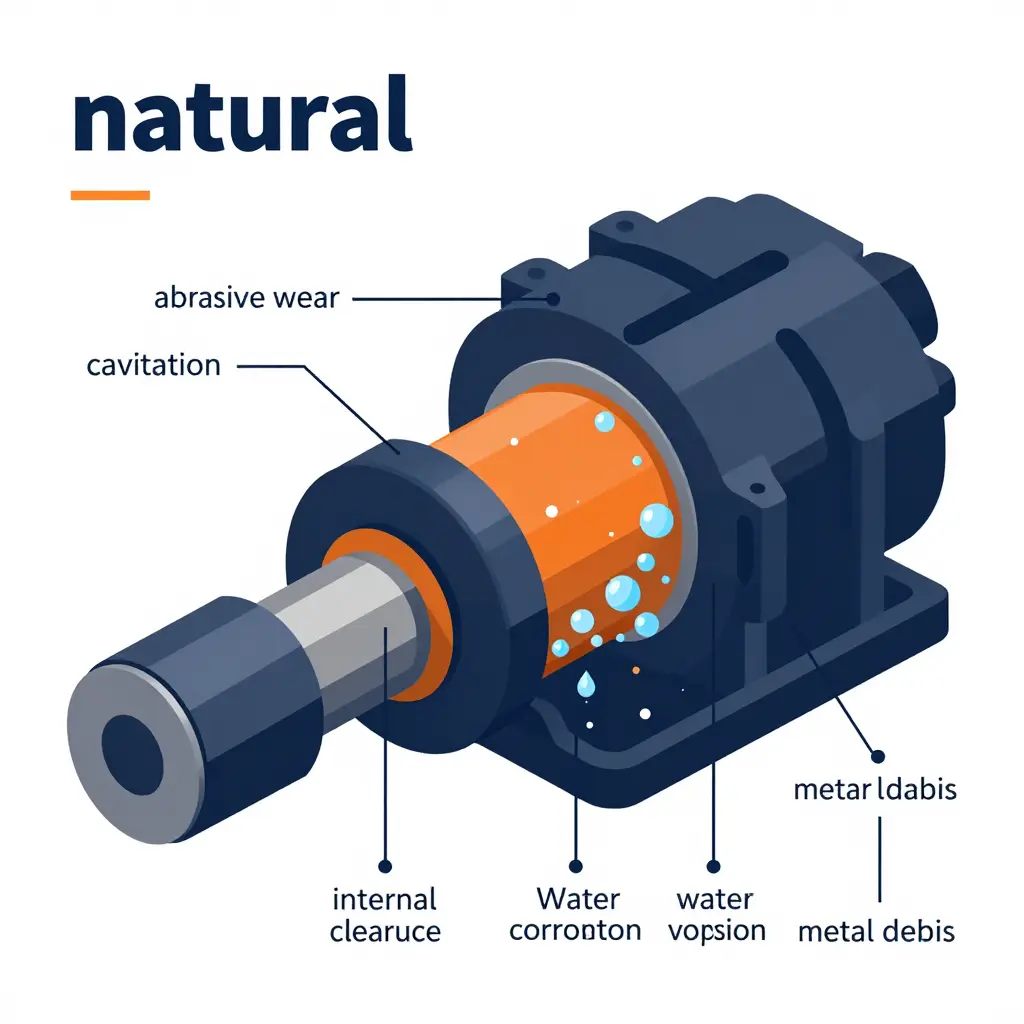
An excavator’s hydraulic pump converts engine rotation into fluid power. Pistons or gears draw oil in and push it out at high pressure, and a film of oil only microns thick keeps the moving metal parts apart. Keep that film intact and the pump lasts; break it and the metal wears.
Abrasive particles: sandpaper inside the pump
Sand, dirt, and metal grains travel with the oil. The clearances between pistons and bores are narrower than a human hair, so the grains cannot pass through; they grind whatever surface they touch. This is abrasive wear. Picture fine sandpaper dragged across a polished mirror: each pass removes a sliver of metal, and after thousands of cycles the clearances have widened enough that the pump struggles to build pressure.
Water and chemical breakdown
Water gets in through condensation or a failing seal. It breaks the oil film, promotes rust, and speeds oxidation, which produces acids, varnish, and sludge. Those deposits clog filters and coat precision surfaces.
Cavitation and erosion
When water or air lowers the oil’s lubricity, a pressure drop can flash the fluid into vapor bubbles. When the bubbles collapse they hammer the metal and pit it, a mechanism called cavitation erosion. Once pitting starts alongside abrasive wear, the surface degrades quickly.
Why viscosity and clearance matter
Viscosity and internal clearances work together. Oil that is too thin lets the film collapse under load; oil that is too thick starves the pump of flow. Contaminants push viscosity outside its designed range, the film fails, and metal contacts metal.
That contact is component seizure. Once surfaces weld and tear, hydraulic pump failure is inevitable, and rebuilding or replacing a pump costs far more than catching the contamination early.
Early Warning Signs of Hydraulic Oil Contamination
Contamination seldom fails a machine outright. It shows up as small clues spread over days or weeks, most of them easy to dismiss. An operator who notices these early warning signs gets time to act; one who does not finds out when the pump seizes.
- Discolored or darkened oil – Oil that turns from clean amber to murky brown or black is oxidizing under heat, and oxidized oil no longer protects the pump’s internals.
- Metallic debris in the filter – Fine sparkles or shavings in the filter element mean metal inside the pump is grinding against metal.
- Rising fluid temperature – A reservoir running hotter than usual points to internal friction and poor lubrication, often the first physical clue that the pump is working against contaminated oil.
- Sluggish or erratic hydraulic response – Slow boom movement, delayed bucket curl, or jerky operation means worn pump components can no longer hold consistent pressure.
- Unusual pump noise – Whining, grinding, or chattering from the pump indicates cavitation or entrained air; the pump is being starved of clean fluid.
- Elevated filter change frequency – Needing filter changes far more often than the schedule calls for means contamination is being generated faster than the system clears it.
- Water or milky emulsion in the reservoir – A cloudy, milky appearance means water has mixed with the oil; it promotes corrosion and breaks down the lubricating film.
- A dropping ISO cleanliness level – When lab tests show the ISO cleanliness code climbing, particle counts are rising and abrasive debris is circulating through the pump.
- Oil seeping around seals and fittings – Fresh weeping at seals or hose connections usually goes with oil that has lost viscosity and no longer seals properly.
- Weak digging force or slow cycle times – Reduced breakout power and longer cycle times mean the pump is losing efficiency to internal wear.
Catch these early warning signs and you can flush the system before a routine service becomes a pump replacement.
Hydraulic Oil Contamination Indicators and What They Signal
The table below maps each symptom or lab result to the contaminant behind it and the damage it does inside the pump.
| Indicator | Likely Contaminant | Implication for the Hydraulic Pump |
|---|---|---|
| Metallic particles (ferrous or non-ferrous) | Wear debris from gears, pistons, or cylinder walls | Piston and bore scoring that accelerates internal wear |
| Water content above 0.1% | Condensation, coolant leaks, or washdown ingress | Loss of lubricity, corrosion, and cavitation damage |
| High silicon levels | Ingested dirt, sand, or quarry dust | Abrasive wear grinding down close-tolerance surfaces |
| Oxidized (darkened, acidic) oil | Sustained heat and overdue service intervals | Sludge and acid buildup that blocks internal passages |
| Varnish buildup | Oil breakdown and thermal deposits | Sticking valves, restricted flow, and overheating |
| Air entrainment | Loose fittings, low reservoir level, or aeration | Cavitation, foaming, and erratic, jerky pump operation |
| Elevated ISO particle counts | General particulate contamination of any origin | Heightened friction and sharply shortened pump life |
Where Hydraulic Oil Contamination Comes From
Contamination seldom comes from one event. It builds over hundreds of operating hours while several contamination sources feed particles, water, and degraded chemistry into the reservoir. Knowing the sources tells you where to look.
The primary contamination sources
- Ingressed particles from the environment. Dust, grit, and debris enter through breather caps, worn cylinder rod seals, and open top-up points. On a machine working in dirt, the reservoir draws them in every time it breathes.
- Internal wear debris. Pumps, motors, and valves all shed microscopic metal flakes as they wear. The flakes circulate as an abrasive slurry and accelerate more wear.
- Contaminated new oil during top-ups. New oil is not automatically clean. Stored in dusty drums or poured through a dirty funnel, it carries particles and moisture into a healthy system.
- Water ingress through seals and condensation. Damaged seals let in rain and wash-down spray, and temperature swings cause condensation inside the tank. Even a small amount of water turns oil milky and strips its lubricating film.
- Chemical degradation from heat and oxidation. Sustained high temperatures oxidize the oil and form varnish, sludge, and acids that attack clearances and internal surfaces.
How each source drives the pump toward failure
Left alone, the sources compound. Particles and wear debris score the precision clearances between the pump’s gears or pistons and its housing, so internal leakage climbs and pressure falls. Water lowers lubricity and promotes corrosion and cavitation pitting. Oxidized oil loses viscosity and forms deposits that block suction strainers and orifices. Together they raise operating temperature, add more contamination, and push the hydraulic pump toward metal-to-metal contact, more noise, and seizure.
Contamination is cumulative. The sooner you find which source is feeding your system, the longer the pump lasts.
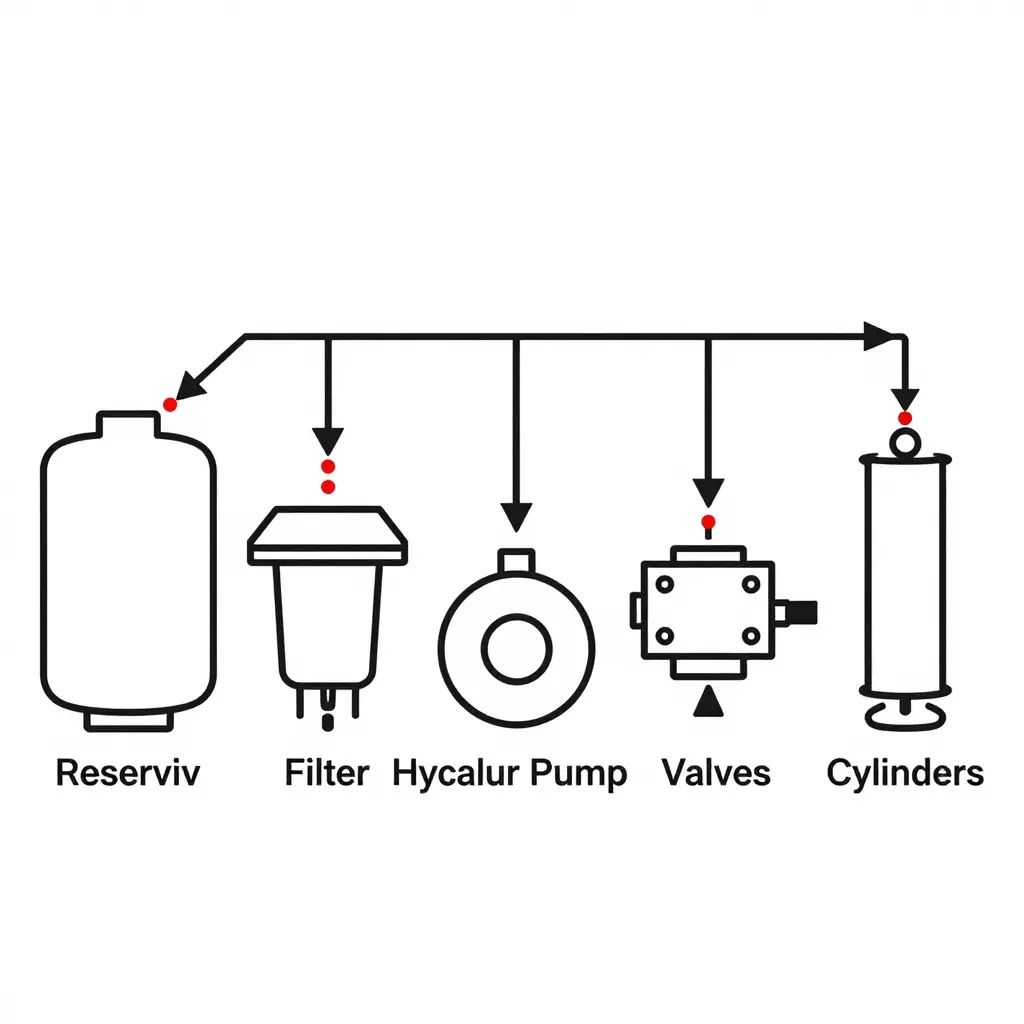
Detecting Contamination: Oil Analysis and Testing Methods
Contamination gives no obvious signal until it has already done damage; abrasive particles can circulate for hundreds of hours before the pump shows symptoms. Testing turns that slow, silent problem into numbers you can act on.
Laboratory Oil Analysis
Laboratory oil analysis anchors any contamination program. A technician draws a representative sample from a live, warm system and ships it to a lab, where analysts measure viscosity, additive levels, oxidation, and suspended debris. The report shows whether the fluid is still doing its job or breaking down.
Particle Counting and ISO Cleanliness Codes
Particle counting measures the number and size of solid particles suspended in the fluid and sorts them into an ISO cleanliness code such as 18/16/13. Higher numbers mean dirtier oil. A rising code points to a clogged filter, an ingested contaminant, or abrasive wear inside the pump.
Spectrometric Wear-Metal Analysis
Spectrometry identifies which metals are in the oil. Iron, copper, chromium, and aluminum each point to particular wearing components: a sudden iron spike hints at cylinder or gear wear, copper at bushing or valve-plate erosion. Followed over time, the readings warn you about the pump before it fails.
Water Content Testing
Moisture testing measures water concentration in parts per million. Even a small amount reduces lubricity and accelerates corrosion, and elevated water usually traces back to condensation or washdown ingress, so it matters on any machine working in damp conditions.
Portable Patch and Field Test Kits
Not every check needs a laboratory. A patch test pushes a measured volume of oil through a membrane, and the stain left behind shows gross contamination. Portable kits approximate water content and viscosity and help you decide whether a full lab sample is urgent.
How Often Should You Test?
Testing works best on a schedule. Take a clean baseline at commissioning, then sample at consistent intervals: particle counting and water checks every 250 hours, full oil analysis and wear-metal testing every 500 hours or at each major service. A heavy-duty cycle, a filter change, or a repair warrants an extra sample.
| Method | What It Reveals | Suggested Interval |
|---|---|---|
| Laboratory oil analysis | Fluid condition, additives, viscosity | Every 500 hours |
| Particle counting | ISO cleanliness code, particle load | Every 250-500 hours |
| Spectrometric wear-metal analysis | Origin of internal wear metals | Every 500 hours |
| Water content testing | Moisture ingress and corrosion risk | Every 250 hours |
| Portable patch/field kits | Quick on-site contamination check | Before major service |
Used together, the methods answer different questions, and their trends matter far more than any single reading.
Contamination and Pump Wear Over Operating Time
The chart below shows what the test results mean in service life. Two curves share a timeline measured in operating hours: the rising concentration of contaminant in the hydraulic oil (slate gray) and the cumulative wear on the hydraulic pump (muted ochre).
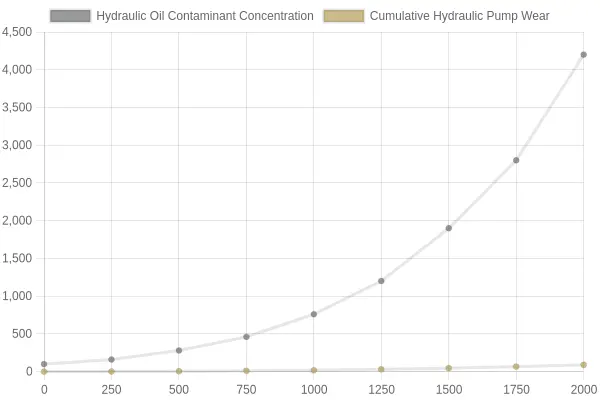
Contaminant levels creep up at first, then bend sharply after roughly 1,000 hours. Pump wear stays almost flat through the opening intervals and climbs steeply in the final third. The wear curve starts its steep rise only after the contamination curve has broken past its early plateau. That lag is the point: dirty oil is the cause, and pump wear is the delayed effect. By the time wear shows up as vibration or heat, the contamination signal has been warning you for hundreds of operating hours.
Treat the progression as a benchmark. If your machine’s contamination trend rises above the gray curve earlier than expected, you probably have an ingress point – a failing breather, a worn seal, or a careless top-up – worth fixing long before the ochre wear curve steepens.
Preventing Hydraulic Oil Contamination: Maintenance Best Practices
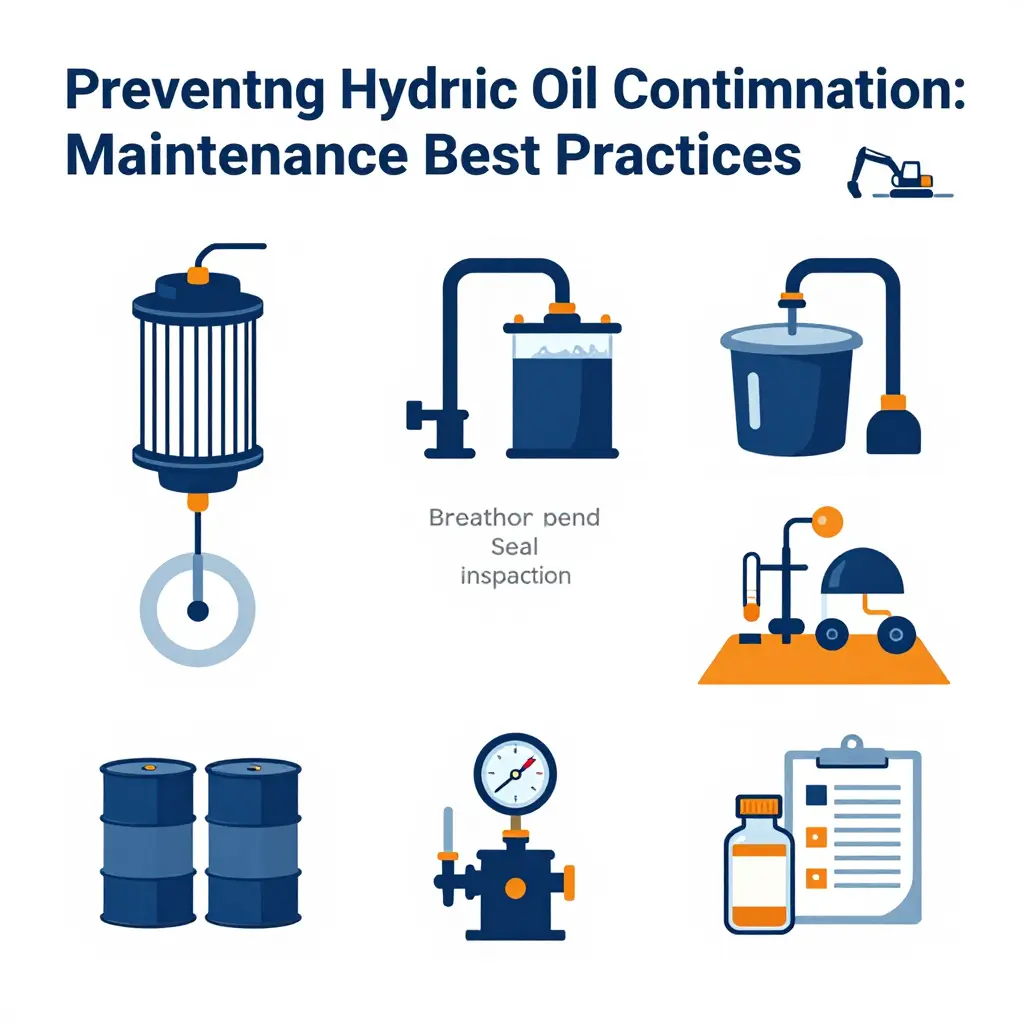
By the time a pump whines or a cylinder drifts, abrasive damage is already underway. Most of it is preventable. A disciplined maintenance routine is the cheapest protection an excavator’s hydraulic system can get.
Follow the manufacturer’s filter schedule
The hydraulic filter is the first line of defense against the particles that score pumps and valves. Replace it at the manufacturer’s interval, not just when it looks dirty. In dusty demolition or quarry work, shorten the interval and watch the restriction indicator.
Control every fluid transfer
Most contamination enters during top-ups, not operation. Use sealed, filtered transfer equipment and clean, dedicated containers. Wipe each coupler and fill port before opening it, and do not reuse grimy funnels or rags that push grit into the reservoir.
Check breathers and seals
A clogged breather pulls dirty air into the tank; a worn seal lets dust in and fluid out. Check both at every service and replace torn wiper seals promptly.
Store oil properly
Keep drums indoors, off the ground, and tightly sealed. Store them on their sides with the bungs horizontal, and label every drum to avoid mixing grades.
Monitor temperature and sample the oil
Heat accelerates oxidation and additive breakdown. Watch reservoir temperature and cooling airflow, and schedule oil analysis to catch wear metals, water, and viscosity changes before they turn into a pump failure.
Quick best-practices checklist
- Replace the hydraulic filter on schedule and after any major repair.
- Transfer fluid only through sealed, filtered equipment.
- Inspect breathers, seals, and wipers at every service.
- Store drums indoors, sealed, and clearly labeled.
- Track fluid temperature and cooling performance.
- Test oil at fixed intervals and act on the results.
Treat clean oil as routine, not a one-time task. Consistent maintenance keeps contamination out of the system, protects the filter and pump, and keeps the excavator working instead of waiting on a repair.
The Cost of a Failed Pump Versus the Cost of Prevention
An unplanned pump failure is never one bill. When contamination pushes a pump past its wear limits, the machine stops mid-task and the costs stack up.
Downtime comes first. A stalled excavator can idle a whole crew, and lost productivity runs from hundreds to several thousand dollars per day depending on the job, before schedule penalties and the cost of a rental machine.
Then come parts. A new pump or a full rebuild typically costs $2,000 to $8,000, and hoses, filters, and fittings add more.
Labor compounds it. Diagnostics, removal, flushing, and reinstallation can take 10 to 20 technician hours, and emergency call-out rates push the figure higher.
Secondary damage is the hidden multiplier. Metal from a failed pump contaminates the reservoir and reaches valves, cylinders, and motors, so one failed pump can turn into a system-wide teardown.
Prevention costs far less. A sampling program usually runs $30 to $100 per test, and good filtration is a small line item next to a rebuild.
An annual preventive maintenance budget – filter changes, particle counts, fluid checks – usually stays under $1,000 per machine, a fraction of one failure.
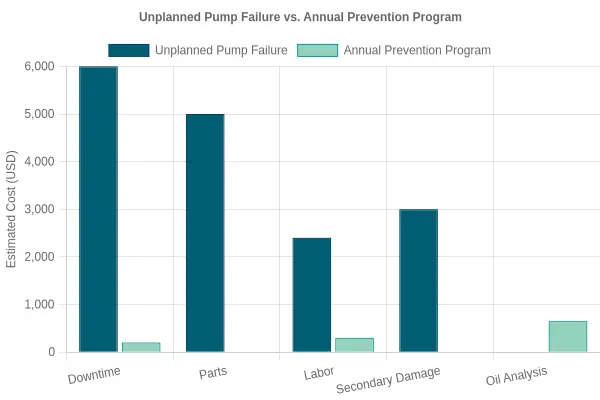
| Cost Category | Unplanned Pump Failure | Annual Prevention Program |
|---|---|---|
| Downtime / lost productivity | $1,500 – $10,000+ per event | Minimal, scheduled only |
| Pump and parts replacement | $2,000 – $8,000 | $0, extends component life |
| Labor (diagnostics, removal, reinstallation, flushing) | 10 – 20 technician hours | 2 – 4 hours |
| Secondary damage (valves, cylinders, motors) | $1,000 – $5,000+ | $0 |
| Oil analysis and filtration | $0, pump already failed | $300 – $1,000 |
| Indicative total | $4,500 – $23,000+ | $300 – $1,000 |
Contamination monitoring costs less than reactive pump replacement.
Frequently Asked Questions About Excavator Hydraulic Oil Contamination
Contamination is one of the leading hidden causes of hydraulic pump failure. These are the questions operators ask most often, with direct answers.
How often should hydraulic oil be tested?
Pull a fluid sample for oil analysis every 500 operating hours or every 90 days, whichever comes first. Machines in dusty, wet, or high-heat conditions should be sampled more often, sometimes every 250 hours. Consistent intervals matter more than any single test, because trends reveal contamination long before parts wear.
What ISO cleanliness level is acceptable?
The right ISO 4406 target depends on how sensitive your hydraulic components are. Most modern excavator systems with high-pressure piston pumps should stay at ISO 18/16/13 or cleaner; older or less sensitive systems can tolerate 19/17/14. Above 20/18/15, abrasive particles are circulating and accelerating wear.
| System Type | Target ISO 4406 Code | Condition |
|---|---|---|
| High-pressure piston pump systems | 18/16/13 | Ideal |
| Standard excavator hydraulics | 19/17/14 | Acceptable |
| Older or tolerant systems | 20/18/15 | Borderline |
| Any system above | 21/19/16 | Action required |
Does discolored oil always signal contamination?
No. Darkening can be normal as additives oxidize and varnish forms over hundreds of hours. Milky or cloudy oil, though, almost always means water intrusion, and a gritty feel or burnt smell suggests heat damage or heavy particle loading. Color alone cannot separate normal aging from real excavator hydraulic oil contamination; oil analysis can.
How does water enter a hydraulic system?
Water gets in through condensation inside a partly filled reservoir, damaged breather filters, worn cylinder rod seals, and high-pressure washdowns that force moisture past seals. Coolant leaks from a failed heat exchanger are another common path. Even a little free water causes corrosion, cavitation, and early pump damage.
Can contaminated oil be cleaned and reused?
In many cases, yes. Offline filtration or kidney-loop systems strip out particulates and water and return the fluid to service. Oil with severe oxidation or additive depletion cannot be recovered and should be replaced. Confirm the result with fresh oil analysis before putting reclaimed fluid back into a high-value machine.
What is the biggest early warning sign of trouble?
Rising particle counts and growing wear metals such as iron and copper in oil analysis reports are the earliest reliable indicators. Catch the trend and you can filter or change the oil before abrasive debris reaches the pump. Ignore it and minor contamination becomes a full hydraulic pump failure.
Key Takeaways for Protecting Your Excavator Hydraulic Pump
Catching excavator hydraulic oil contamination early costs far less than rebuilding or replacing a pump. The warning signs rarely arrive together, which is where an attentive operator or technician has the advantage. Sluggish boom or bucket response, rising oil temperature, a whining or growling pump, dark or milky fluid, and metal shimmer in the reservoir all mean particles, water, or varnish are circulating. Left alone, they lead to scored bores, stuck spools, and a pump failure that sidelines the machine.
Routine oil analysis replaces guesswork with data. Regular sampling tracks particle counts, water content, and wear metals so you can service the system before damage sets in. Combined with preventive maintenance, it protects both the excavator hydraulic pump and the project schedule.
- Watch for early warnings: slow cycle times, hotter-than-normal oil, unusual pump noise, and discolored fluid.
- Sample your oil on a fixed schedule and act on the results, not just the calendar.
- Change filters and fluid at recommended intervals, and keep the reservoir sealed against dust and moisture.
- Inspect fittings, breathers, and seals regularly to stop contaminants at the source.
- Train operators to report changes in machine feel; small observations prevent big failures.
Treat every symptom of excavator hydraulic oil contamination as a reason to investigate rather than to wait. Consistent monitoring and timely maintenance are the most reliable way to keep a hydraulic pump running clean and cool.